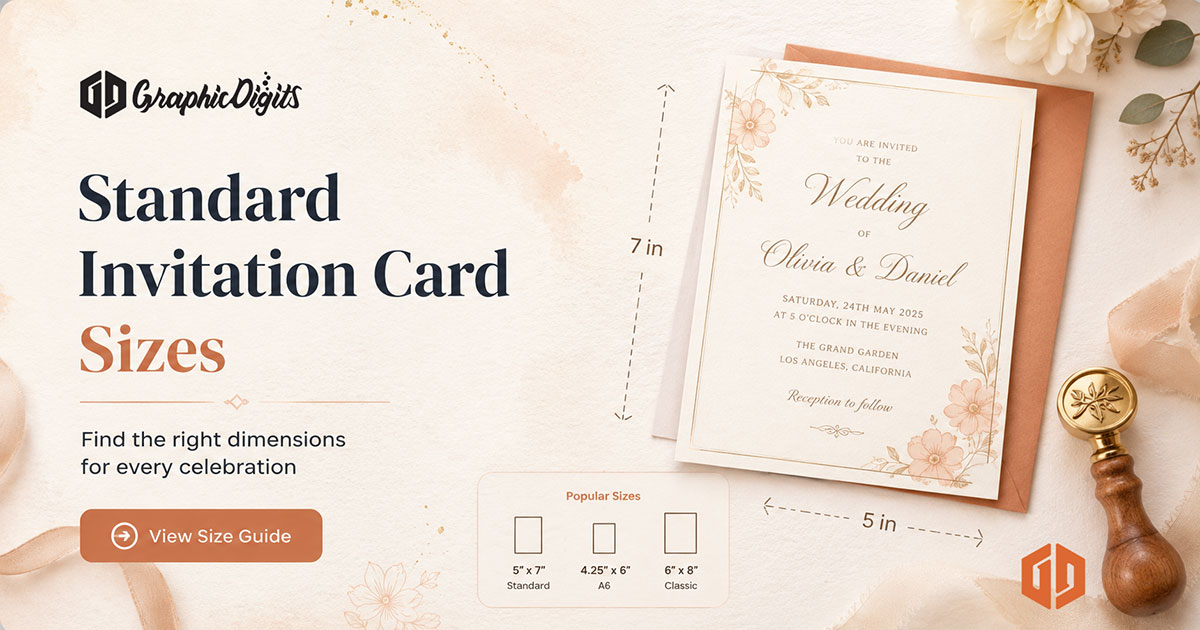
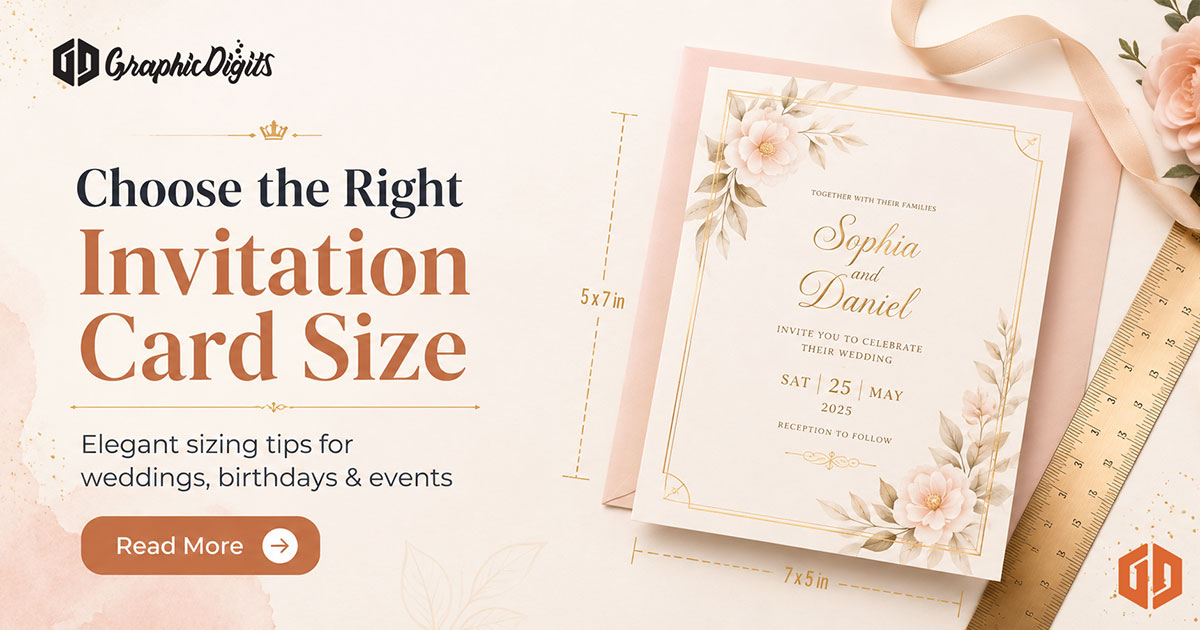
A common standard invitation card size is 5 × 7 inches, with other sizes used for RSVP cards, save-the-dates, square invitations and digital formats. Most people searching for invitation card size need a fast, practical answer: which dimensions work, how they convert to centimetres and millimetres, and which envelopes they fit.
No single size is mandatory. Printers, envelope stock, postage rules and event style all affect the final choice. This guide covers common print sizes, wedding and event formats, digital options, envelopes, and production details such as bleed and safe area. For design direction beyond dimensions, see invitation card design.
Common invitation sizes at a glance
These are widely used US invitation sizes. The standard invitation card size is typically 5 × 7 inches (about 12.7 × 17.8 cm / 127 × 178 mm). Envelope codes (A7, A6, A1) refer to common stationery envelope names, not ISO paper sheet sizes.
| Use | Inches | Approx. cm | Approx. mm | Orientation | Common envelope |
|---|
| Standard / main invitation (wedding, formal event) | 5 × 7 | 12.7 × 17.8 | 127 × 178 | Portrait | A7 (about 5.25 × 7.25) |
| Compact invitation / save the date | 4.25 × 5.5 or 4.25 × 6 | 10.8 × 14.0 or 10.8 × 15.2 | 108 × 140 or 108 × 152 | Portrait | A2 / A6-style options |
| Postcard-style invite | 4 × 6 | 10.2 × 15.2 | 102 × 152 | Portrait | 4.25 × 6.25 style mailers |
| RSVP or details insert | 3.5 × 5 | 8.9 × 12.7 | 89 × 127 | Portrait | A1 (about 3.625 × 5.125) |
| Square invitation | 5.25 × 5.25 or 6 × 6 | 13.3 × 13.3 or 15.2 × 15.2 | 133 × 133 or 152 × 152 | Square | Matching square envelopes |
Portrait (taller-than-wide) remains the default for formal cards. Landscape works well for photo-led or programme-style invites when the envelope stock supports it.
Wedding invitation sizes
A common wedding invitation size for the main card is 5 × 7 inches (about 12.7 × 17.8 cm)—the same standard wedding invitation size used in many US suites. Suites then add smaller inserts so guests can respond and find logistics without overcrowding the main card:
- Main wedding invitation: 5 × 7 inches (portrait) with an A7 envelope
- Save-the-date: often 4.25 × 5.5 or 4.25 × 6 inches when the message is shorter
- RSVP card size: about 3.5 × 5 inches (about 8.9 × 12.7 cm) with an A1-style envelope
- Details / accommodation inserts: typically match the RSVP size or a compact insert so the stack fits the same envelope system
Keep type hierarchy clear: names and date first, logistics second. For wedding styling and suite layout—not dimensions—see our wedding card design guide once size is decided.
Corporate and event invitation sizes
Corporate dinners, galas and conferences commonly use 5 × 7 for formality, or 4 × 6 / 4.25 × 6 when the message is shorter and postage or mailing volume matters. Birthday and party invitations commonly use the same 5 × 7-inch or 4 × 6-inch formats, depending on how much event information and imagery the design needs. Event invites that double as handouts benefit from slightly larger type and fewer competing elements. For event creative direction, see event card design.
Square invitation sizes
Squares such as 5.25 × 5.25 or 6 × 6 inches feel modern and centred. Confirm postage early—square envelopes often cost more to mail than standard rectangular formats.
Digital invitation dimensions
Digital sizes depend on the channel:
- Stories / vertical video frames: 1080 × 1920 px
- Square social posts: 1080 × 1080 px
- Print-like PDF or email attachment look: design at 5 × 7 inches and export around 1500 × 2100 px at 300 dpi for sharp screen viewing
- Email-inline graphics: keep width near 600 px and avoid tiny body text
Design for the smallest intended screen first, then scale assets for each platform rather than assuming one file fits every feed.
Matching envelope sizes
Always size the card to the envelope, not the other way around. Leave a little clearance so intercalated cards and envelopes do not scrape. Popular pairings: 5 × 7 cards with A7 envelopes, RSVP-size cards with A1 envelopes, and square cards with matching square envelopes.
Bleed, trim, safe area and resolution
For print, builders typically need:
- Bleed: about 0.125 inches (3 mm) beyond the trim line when backgrounds or photos reach the edge
- Safe area: keep important text and logos roughly 0.125–0.25 inches inside the trim
- Resolution: 300 dpi at final size for photo and fine type work is a common print target
Exact templates differ by printer. Ask for their dieline or blank invitation template before final export.
How content volume affects size choice
Short announcements can use compact 4 × 6 or save-the-date sizes. Multi-line ceremony details, dual languages or layered branding usually need 5 × 7 or a suite with inserts. Overcrowding a small card is harder to fix later than choosing a size with room.
Common size-selection mistakes
- Designing the card before checking available envelope stock
- Forgetting postage rules for squares or thick suites
- Placing text too close to the edge with no safe margin
- Exporting screen files at 72 dpi for professional print
- Assuming ISO A-series sheet sizes match US “A7 invitation” naming
When a custom size is appropriate
Custom sizes make sense for branded event systems, unusual folds, die-cuts or coordinated suites that do not fit standard shells. They usually need earlier printer confirmation and may raise material or postage costs. For unique formats beyond standard stationery shells, compare notes with custom card design and flatter mail formats such as postcard design.
If you are choosing among greeting-style cards rather than formal invitation suites, our greeting cards guide can help separate formats.
Conclusion
Start with the standard invitation card size of 5 × 7 inches for most printed invitations, then adjust for postage, envelope stock, content length and whether the invite is print, digital or both. Confirm bleed, safe area and final envelope size before artwork is locked.
Need help preparing a print-ready invitation suite? Explore our stationery design services or request a free design quote from Graphic Digits.
Frequently asked questions about invitation card size
What is the most common invitation card size?
The standard invitation card size in many US print workflows is 5 × 7 inches (about 12.7 × 17.8 cm / 127 × 178 mm). It fits easily in A7 envelopes and leaves room for names, details and design.
What size are wedding invitations usually?
A common wedding invitation size is 5 × 7 inches for the main card—the standard wedding invitation size in many US suites—with smaller inserts such as about 3.5 × 5 inches (about 8.9 × 12.7 cm) for RSVP or details cards. Exact suites vary by designer and printer.
What size should a digital invitation be?
Digital invitations are flexible. Common starting points include 1080 × 1920 pixels for stories, 1080 × 1080 pixels for square posts, and a 5 × 7 inch layout exported at 1500 × 2100 pixels (300 dpi) when you want a print-like proportion on screen.
How much bleed do invitation print files need?
Many printers ask for about 0.125 inches (3 mm) of bleed beyond the trim edge, plus a safe margin inside the trim so text and logos are not cut off. Always confirm your printer’s exact template.
How do invitation sizes convert to centimetres?
Convert from the same print measurements used in inches or millimetres. For example, the standard 5 × 7 inch invitation is about 12.7 × 17.8 cm (127 × 178 mm). Compact and RSVP sizes on this page use the same inch-to-cm conversion.