What the design thinking process is
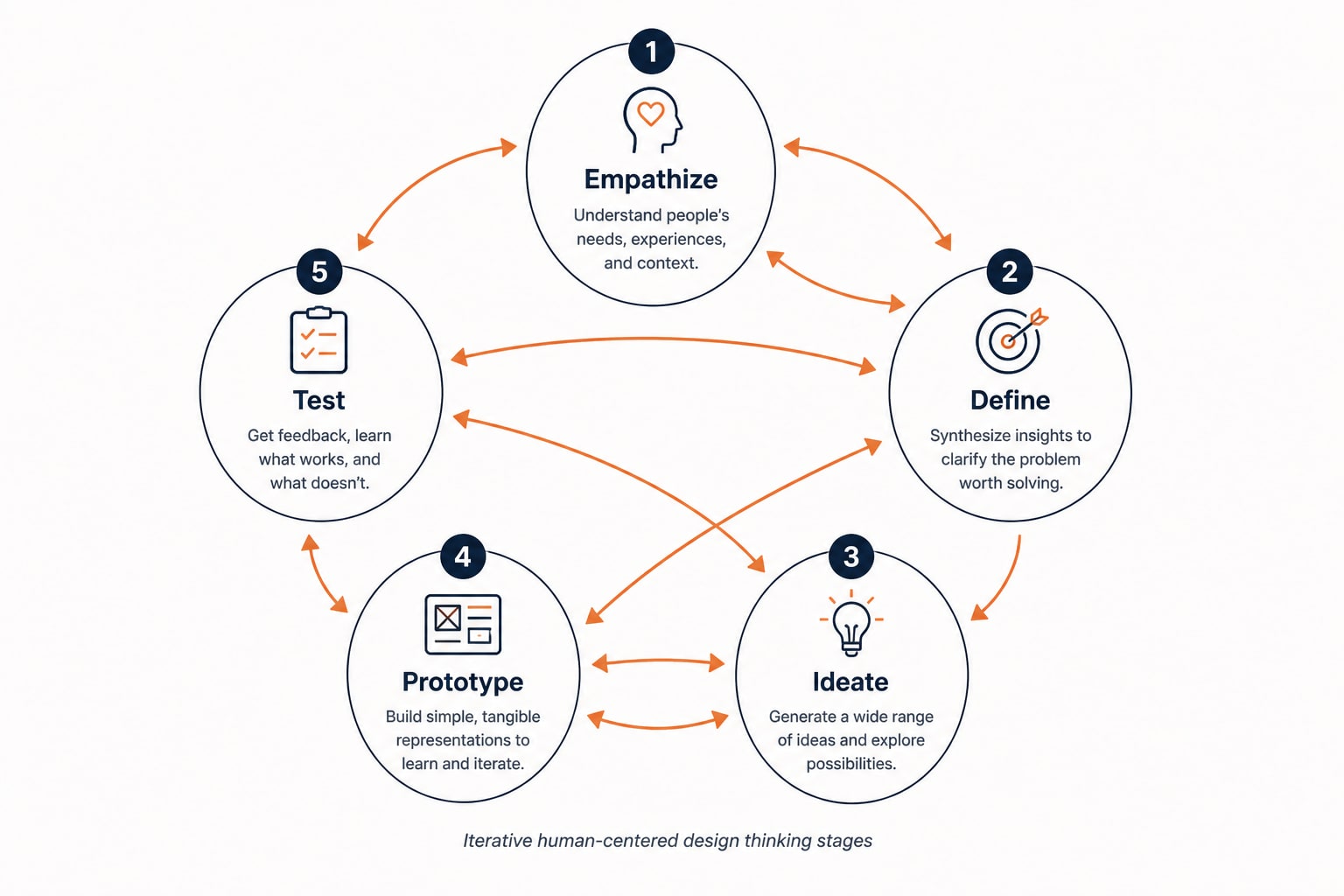
The design thinking process is an iterative way to solve problems through five connected stages: Empathize, Define, Ideate, Prototype and Test. Teams may move forward, backward or repeat stages as new information emerges. In graphic design, the same approach can help clarify audience needs, explore concepts and test visual solutions before finalizing creative work.
This guide explains that five-stage workflow in depth—how stages interact, why loops matter and how the method applies to communication problems. It is not GraphicDigits’ commercial delivery checklist. For how GraphicDigits typically runs client engagements, see our process. For the design thinking mindset behind the stages, see the companion article. For categories of visual work the method can inform, browse types of graphic design.
Why teams use the process
- Requirements are uncertain or stakeholders disagree on the real need
- Audience needs are unclear and easy to assume without evidence
- Multiple solutions are possible and early validation is cheaper than late redesign
- Cross-functional teams need a shared language for exploration and feedback
The five stages at a glance
- Empathize — learn from people in context
- Define — turn insights into a focused problem statement
- Ideate — generate many possible directions before judging
- Prototype — make ideas concrete enough to react to
- Test — gather feedback and decide what to refine next
Treat the list as a workflow map, not a contract. Mature teams move back and forth as evidence changes. A design thinking steps guide can summarize the sequence quickly, but the design thinking process is not a rigid checklist; teams often loop between stages as insights change.
1. Empathize
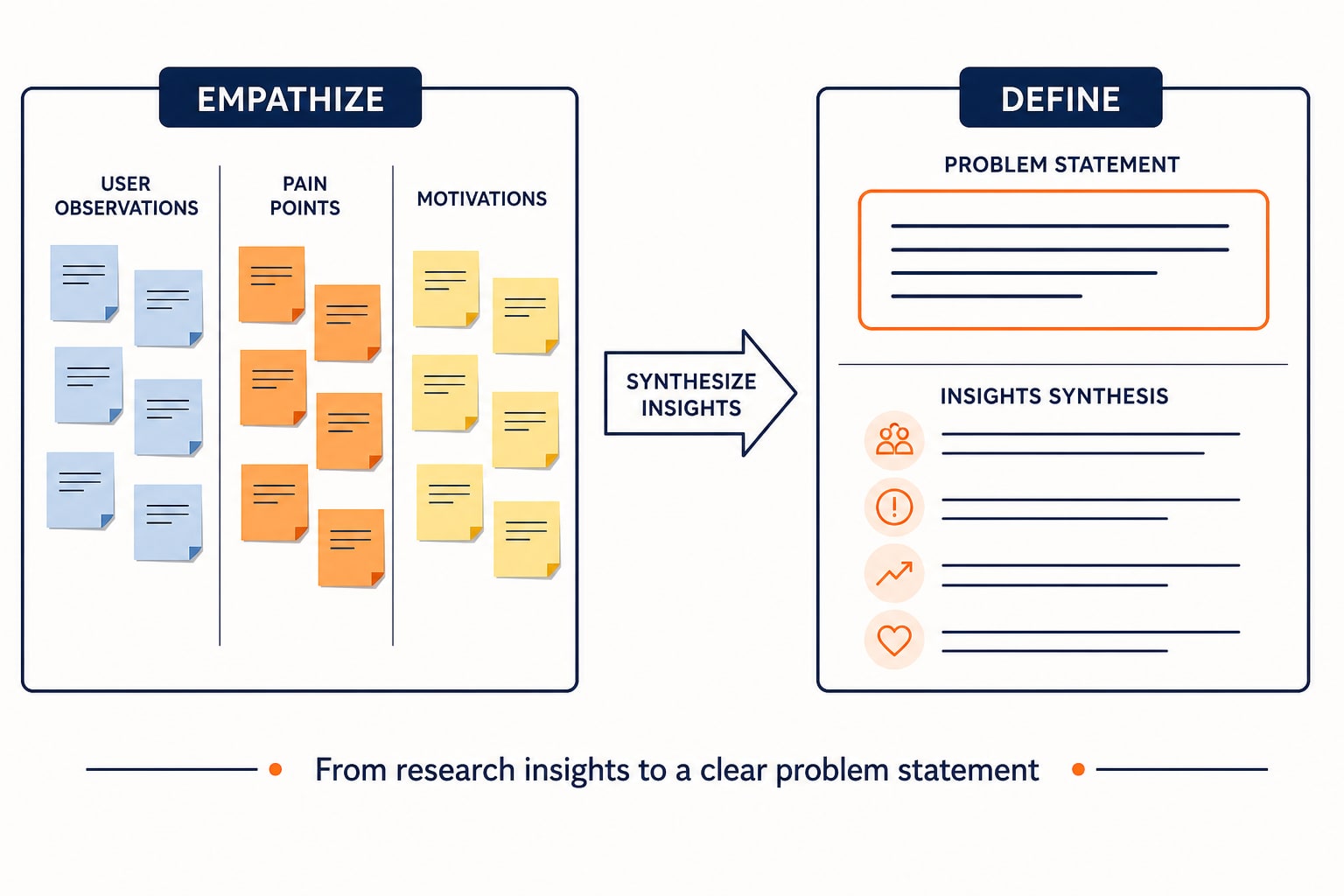
Purpose: understand people in their real context—goals, constraints, emotions and workarounds—before inventing solutions. Methods can include interviews, observation, support ticket review, field notes or journey mapping. Capture what people do and say, not only what stakeholders prefer to believe.
- Ask open questions; follow unexpected answers
- Separate observations from interpretations
- Look for patterns across multiple people, not one anecdote
Practical outcome: evidence about audience behavior you can carry into Define. Empathy work often loops back later when a test shows the problem frame was incomplete.
2. Define
Purpose: turn raw learning into a sharp problem frame—who struggles, what stands in the way and what success would change. A useful problem statement guides ideation; a vague one invites endless brainstorming without direction.
- Synthesize themes from empathy research
- Write a human-centered problem statement the team can test against
- Name assumptions you still need to check
Practical outcome: a clear communication or product problem—not a disguised solution (“we need blue”). Teams revisit Define after testing when evidence shows they framed the wrong need.
3. Ideate
Purpose: expand the solution space before narrowing it. Quantity comes first; critique comes later. Techniques range from sketch storms and “how might we” prompts to competitive teardown and constraint-stretching exercises.
- Separate generating ideas from scoring them
- Include wild options so safer ideas can learn from them
- Cluster concepts before selecting a shortlist to prototype
Practical outcome: a shortlist of directions worth making tangible. Prototype feedback often sends teams back to Ideate for a second round rather than polishing the first idea.
4. Prototype
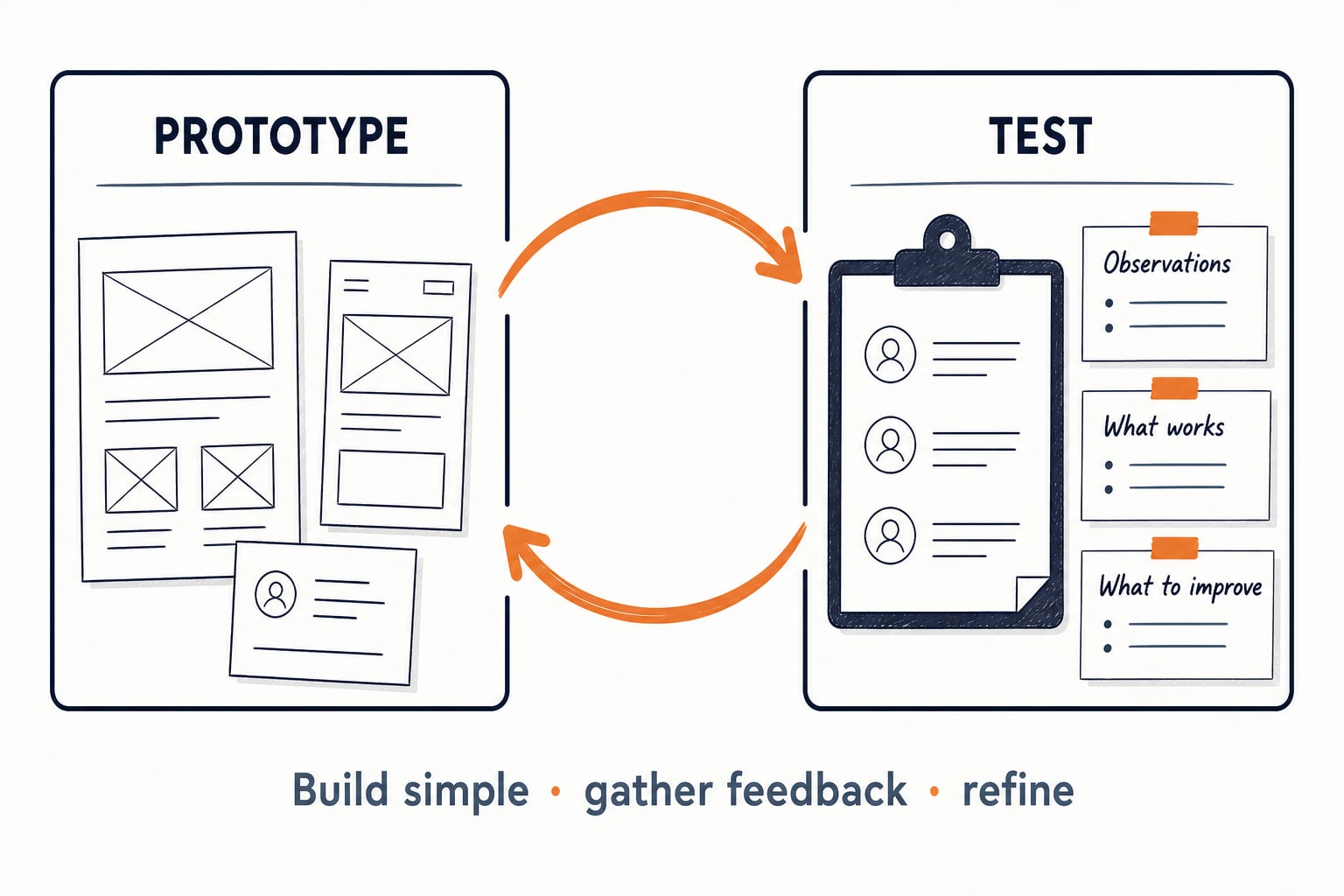
Purpose: make ideas tangible enough for reaction—paper flows, clickable wireframes, service role-play or lightweight brand mockups. Fidelity should match the question you are asking. Heavy polish too early hides risk.
For interface-focused detailing after early exploration, related reading includes mobile app prototyping and iterative UX design process guidance.
Practical outcome: something people can react to this week—not a finished production file. Prototypes exist to expose wrong assumptions before craft investment grows.
5. Test
Purpose: learn from reaction—not run a final exam. Watch people attempt the prototype, note confusion and collect why something worked or failed. Then decide whether to refine the prototype, revisit ideation or return to empathy when the problem frame itself was wrong.
- Test with people close to the intended audience when possible
- Ask them to complete tasks; observe before interrupting
- Capture evidence that changes priorities for the next loop
Practical outcome: decisions about what to refine, pivot or stop—evidence that drives the next stage transition in the workflow.
Non-linear movement between stages
The design thinking process is iterative, non-linear and feedback-driven. Treat stages as connected workflow steps teams can enter, exit and revisit—not a one-way waterfall.
- Revisit Define after testing when the problem statement no longer matches what people struggle with
- Ideate again after prototype feedback when the shortlist missed a better direction
- Return to Empathize when assumptions fail and the team needs fresh audience evidence
Plan for loops instead of blaming “scope creep” when evidence earns a change. That looped workflow is what separates a process deep-dive from a quick numbered sequence.
Design Thinking in Graphic Design
Graphic design thinking applies the same five stages to communication problems—not as a claim that every creative project must follow Design Thinking, but as one structured approach inside a broader graphic design creative process. It helps designers move from a vague request (“make it modern”) to a defined communication problem before exploring visual solutions.
- Empathize: understand the audience, client stakeholders and how people currently encounter the message or brand
- Define: clarify the real communication problem—what confusion, trust gap or action barrier the design must address
- Ideate: explore multiple visual and message directions before locking one look
- Prototype: create rough layouts, concept boards or mockups at fidelity that matches the question
- Test: review comprehension, usability, hierarchy or stakeholder/audience feedback, then refine
The stages still work best when teams stay curious, user-centered and willing to test assumptions—the mindset behind design thinking—without turning this process guide into a philosophy essay.
Practical examples (non-fabricated patterns)
- Local service campaign (graphic design): Empathize with why prospects ignore past handouts, define the trust or clarity barrier, ideate message and layout angles, prototype a flyer face, then test comprehension with a small audience and refine hierarchy before print-ready files.
- Website redesign: Observe task failures, define the navigation problem, ideate IA options, prototype clickable paths and test key journeys—see also website design services when you need production work after the method clarifies direction.
- App feature: Interview users about workaround habits, define the unmet job, ideate flows, prototype low-fi screens and test. Narrow UX patterns are covered in mobile app UX design.
When the process helps
Use the design thinking process when requirements are uncertain, user or audience needs are unclear, multiple solutions are possible, or testing can reduce assumptions before heavy build or production investment. Do not force every print tweak or known maintenance task through a full five-stage ceremony—simple production fixes still need craft; they may not need fresh research.
Common mistakes
- Treating stages as rigid and refusing to loop when evidence changes
- Jumping to polished visual solutions before the communication problem is clear
- Defining the wrong problem—or writing a “problem” that is really a preferred solution
- Skipping prototype and testing because deadlines feel tight
- Treating feedback as final approval instead of evidence for the next loop
- Confusing the method with a vendor’s delivery timeline
How teams collaborate with the framework
Design thinking works best when research, design, content and stakeholders share artifacts—insight boards, problem statements, concept clusters and test notes. Lightweight facilitation beats long slide decks. Applied outcomes eventually show up in a design portfolio; the method itself stays educational here. Commercial craft support for visual systems also sits under graphic design services and mobile app design.
Quick checklist
- Who are we learning from, and what will we observe?
- What problem statement will guide the next ideas?
- Which assumptions are still untested?
- What is the lightest prototype that answers today’s question?
- What evidence will tell us to refine, pivot or stop?
Conclusion
The design thinking process is a practical, iterative workflow for understanding people, framing problems and learning through prototypes and tests—including graphic-design communication challenges. Keep the stages flexible, evidence-led and separate from sales delivery claims. For a quick numbered sequence, use the five design thinking steps guide. For how GraphicDigits structures client delivery after discovery, visit our process.
Frequently asked questions about the design thinking process
What are the five stages of the design thinking process?
The five commonly referenced stages are Empathize, Define, Ideate, Prototype and Test. Teams use them to understand people, frame problems, generate options, build lightweight versions and learn from feedback.
Is design thinking a linear process?
No. The stages are a helpful map, not a waterfall checklist. Teams often revisit earlier stages when new insights appear—especially after testing.
When should a team use the design thinking process?
Use the process when requirements are uncertain, audience needs are unclear, multiple solutions are possible, or early testing can reduce costly assumptions—such as new campaigns, interfaces, or brand messages that need validation before heavy production.
How does design thinking apply to graphic design?
It helps move from a vague request to a defined communication problem before exploring visuals. Empathize with the audience, define the message barrier, ideate directions, prototype rough layouts or mockups, then test comprehension, hierarchy and feedback before finalizing files.
What is the difference between design thinking and a normal project workflow?
Design thinking is a human-centered problem-solving method. A commercial project workflow is an agency’s delivery path (kickoff, production, review, launch). Both can coexist; they answer different questions.